Sweetness is an important component of apple flavor, and when balanced with acidity (or tartness) is associated with overall apple eating quality. In apple fruit, sweetness is determined by levels of individual sugars, including fructose, glucose, sucrose, and sorbitol. Of these sugars, fructose is typically perceived as sweeter than the other sugars, particularly sucrose (Hanover and White, 1993).
The degree of genetic control of sweetness is typically lower than for other breeding targets with a broad sense heritability of only about 0.2-0.3.
A large effect trait locus for fruit fructose concentration was identified on apple linkage group (chromosome) 1 and named LG1Fru (Guan et al. 2015). LG1Fru was consistently associated with fructose differences across years and from harvest through storage and explained almost all of the genetic variance in fructose concentration across a large set of breeding germplasm from the Washington State University apple breeding program.
This locus also explained a smaller but significant amount of variance for the individual sugars of glucose, sucrose, and sorbitol, but interestingly was not associated with soluble solids content (SSC), the commonly used instrumental measure of sweetness (for better or worse). Because of the complexity of the SSC measurement, it is not surprising that not one single region of the genome was found to be consistently associated with apple fruit SSC.
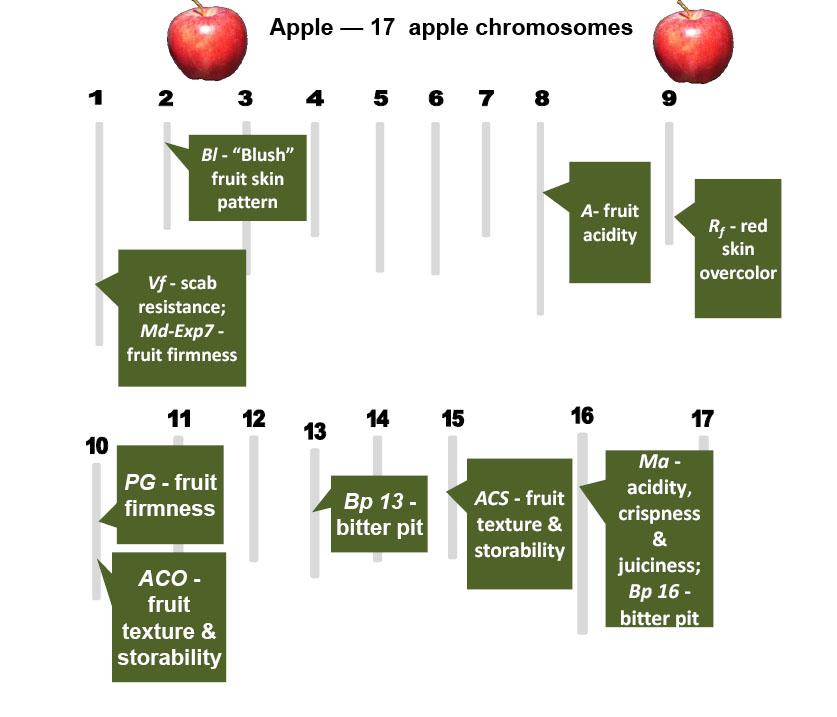
Apple breeders already have access to DNA tests to select for many other components of apple fruit quality, including apple texture (Md-ACS1 = Jewel 1) crispness, juiciness, acidity (Ma locus = Jewel 6), and firmness (Md-PG1 = Jewel 9). With genetic knowledge of which apple seedlings will most likely have high fructose content (along with the other components of apple fruit quality), breeders can plan crosses to maximize the probability of obtaining selections with excellent fruit quality.
Therefore, because knowledge of this genetic region will lead to more efficient breeding of apple cultivars, it is chosen as one of RosBREED’s “Jewels in the Genome.”
References
Guan Y, Peace C, Rudell D, Verma S., Evans K. 2015. QTLs detected for individual sugars and soluble solids content in apple. Molecular Breeding 35:125.
Hanover, L.M. and J.S. White. 1993. Manufacturing, composition, and applications of fructose. Am. J. Clin. Nutr. 58:724S-732S.